30 Keto Breakfast Ideas: Fast, Filling, and Under 5g Net Carbs
Skip the cereal aisle. These 30 keto breakfast ideas are fast to make, genuinely filling, and each one keeps net carbs under 5 grams so you start the day in ketosis, not out of it.
Medically reviewed by Dr. Julian Reyes, RD · PhD Nutritional Sciences, Registered Dietitian
Every article on Keto Kitchen Hub is fact-checked against peer-reviewed research and reviewed by a registered dietitian before publication. This content is for educational purposes and is not medical advice.
Breakfast is where a lot of new keto eaters quietly fall off the wagon. Not because they lack willpower, but because the default American breakfast - cereal, toast, orange juice, a banana, a bagel - is basically a carb delivery system dressed up as a meal. When you cut those staples out, the question that follows almost immediately is 'okay, so what do I actually eat in the morning?' This guide answers that question thirty different ways, with an emphasis on speed, satiety, and staying comfortably under 5 grams of net carbs per serving.
Net carbs, for anyone who needs a quick refresher, are total carbohydrates minus fiber (and minus most sugar alcohols, though we're cautious about those since not everyone tolerates them the same way). Fiber isn't digested and absorbed the way starch and sugar are, so it doesn't spike blood glucose or interfere with ketosis for most people. That's why a breakfast built around eggs, avocado, and leafy greens can look almost carb-free on the net carb line even though the total gram count on the label might be a bit higher.
Why breakfast trips people up on keto
Breakfast culture is deeply carb-coded. Cereal, oatmeal, pancakes, muffins, smoothies loaded with fruit, granola bars - these are the foods marketed to us as 'quick' and 'energizing.' On keto, most of that category is off the table, and a lot of beginners default to just skipping breakfast or eating the same three eggs every single day until they burn out on eggs entirely. Neither approach is sustainable long term. The fix isn't willpower, it's variety: having a rotating list of go-to options so breakfast never feels like a chore or a guessing game.
There's also a physiological piece worth mentioning. Many people find that a higher-protein, higher-fat breakfast keeps them fuller for longer than a carb-heavy one, simply because protein and fat are digested more slowly and don't trigger the same blood sugar swing that leads to mid-morning hunger. If you've ever eaten a bowl of cereal and been ravenous by 10am, that's the mechanism at play. A keto breakfast, done right, tends to buy you four to six hours of genuine satiety rather than ninety minutes.
The building blocks of a fast keto breakfast
Before the list, it helps to understand the handful of ingredients that make almost every one of these recipes possible. Once you stock these, you can improvise your own combinations endlessly, which is really the goal - not memorizing thirty recipes, but internalizing a pattern.
- Eggs - the single most versatile keto breakfast ingredient; essentially zero carbs, high in protein and choline.
- Full-fat dairy - cheese, cream cheese, sour cream, heavy cream, and full-fat Greek yogurt (in moderation, since yogurt has some carbs).
- Avocado - creamy, filling, rich in fiber and potassium, and low enough in carbs to eat half or a whole one most days.
- Leafy greens and low-carb vegetables - spinach, mushrooms, bell pepper, zucchini, tomato (in small amounts).
- Bacon, sausage, and other fatty proteins - useful for flavor and staying power, though it's worth choosing quality when you can and not making processed meat the daily default.
- Nut butters and nuts - almond butter, macadamia nuts, and pecans add crunch and healthy fats without much carb load.
- Coconut and almond flour - the backbone of keto pancakes, muffins, and waffles (see our companion guide on keto flour substitutes for the details on how each behaves).
- Unsweetened almond or coconut milk - a base for smoothies and chia puddings without the sugar of regular milk.
- Chia seeds and flaxseed - fiber-rich thickeners that turn liquid into pudding and barely register as net carbs.
5 egg-based breakfasts (ready in under 10 minutes)
Eggs deserve their reputation as the keto breakfast MVP, but 'eggs every day' doesn't have to mean 'the same eggs every day.'
- Cheesy scrambled eggs with spinach - whisk two eggs with a splash of cream, fold in a handful of wilted spinach and shredded cheddar. About 2g net carbs.
- Avocado egg boats - halve an avocado, crack a small egg into each pit, bake at 400F for 15 minutes, top with everything-bagel seasoning. About 3g net carbs.
- Bacon and egg cups - line a muffin tin with bacon, crack an egg into each cup, bake until set. Portable, freezer-friendly, about 1g net carbs each.
- Cream cheese scrambled eggs - the diner-style trick: fold small cubes of cream cheese into eggs while scrambling for an ultra-creamy texture. About 2g net carbs.
- Spanish-style baked eggs (huevos rancheros, keto style) - eggs baked in a skillet of sauteed peppers, onion (small amount), and a low-sugar tomato sauce, topped with cotija cheese. About 5g net carbs.
6 no-cook and grab-and-go options
Not every morning allows for a skillet. These are the mornings-are-chaos options, several of which can be prepped the night before as part of your weekly routine - the same logic we walk through in our 7-day keto meal plan.
- Chia seed pudding - mix chia seeds with unsweetened almond milk, a few drops of stevia or monk fruit, and vanilla; refrigerate overnight. About 4g net carbs per serving.
- Keto trail mix cup - macadamia nuts, pecans, unsweetened coconut flakes, and a few dark chocolate chips (85%+ cacao). About 3g net carbs.
- String cheese and macadamia nuts - genuinely just that, eaten in the car. Under 2g net carbs.
- Cold cuts and cheese roll-ups - turkey or ham slices wrapped around cream cheese and a slice of cheddar. About 1g net carbs.
- Full-fat Greek yogurt with berries and flax - a small portion of plain full-fat yogurt with a few raspberries and a tablespoon of ground flaxseed. About 5g net carbs; keep the berry portion small to stay in range.
- Keto protein shake - unsweetened almond milk, a scoop of low-carb protein powder, a tablespoon of nut butter, and ice, blended. About 3-4g net carbs depending on the protein powder.
5 keto pancakes, waffles, and baked goods
Yes, you can still have pancakes. The texture is different from wheat-flour pancakes - usually a bit denser and more custardy - but most people adjust quickly, especially with the right toppings.
- Almond flour pancakes - almond flour, eggs, cream cheese, and a touch of baking powder, blended smooth and cooked low and slow. About 4g net carbs for two small pancakes.
- Coconut flour waffles - coconut flour absorbs a lot of liquid, so these use more eggs and butter than a wheat recipe would; crisp on the outside, soft inside. About 3g net carbs.
- Cream cheese pancakes (the 'two-ingredient' classic) - just eggs and cream cheese blended and cooked like crepes; thin, eggy, and almost carb-free.
- Keto blueberry muffins - almond flour muffins with a small handful of blueberries folded in; freeze extras for grab-and-go mornings. About 4g net carbs each.
- Chaffles (cheese waffles) - shredded cheese and egg cooked in a mini waffle iron; savory, crisp, and endlessly customizable with add-ins like jalapeno or bacon bits. About 1g net carb.
5 savory, veggie-forward breakfasts
If sweet breakfasts aren't your thing, or you just want to get a vegetable serving in early, these lean savory.
- Zucchini and feta frittata slices - bake a frittata on Sunday, slice it into six portions, reheat through the week. About 3g net carbs per slice.
- Mushroom and gruyere omelet - sauteed mushrooms folded into a two-egg omelet with melted gruyere. About 3g net carbs.
- Cauliflower hash browns - riced cauliflower squeezed dry, mixed with egg and cheese, pan-fried into patties. About 4g net carbs.
- Sausage and pepper skillet - crumbled breakfast sausage cooked with diced bell pepper and onion, topped with a fried egg. About 4g net carbs.
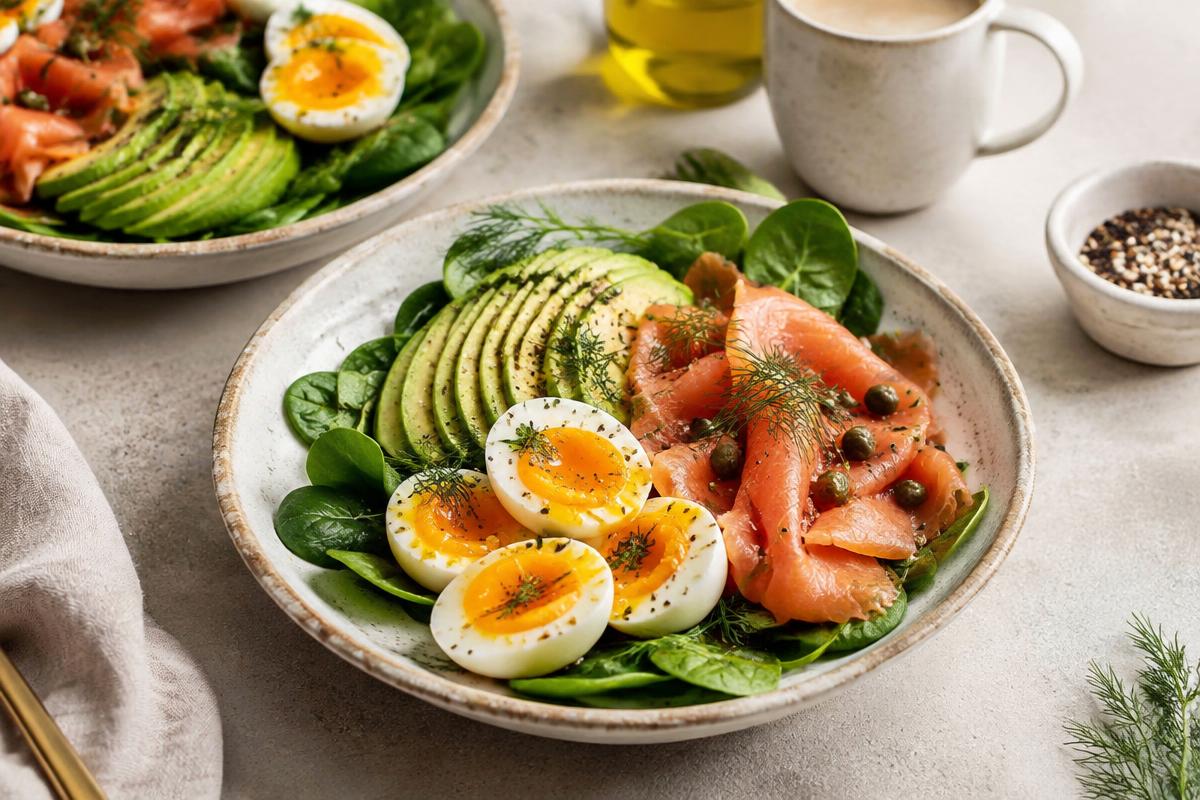
- Smoked salmon and cream cheese roll-ups with capers - no bagel required; the flavor combination holds up fine on its own or wrapped in a low-carb tortilla. About 2g net carbs.
4 smoothies and shakes that won't spike your glucose
Traditional smoothies are often a sugar bomb dressed up as health food - a banana, a cup of orange juice, and some honey can easily add up to 60+ grams of carbs. These versions use fat and fiber instead of fruit sugar to create body and creaminess.
- Avocado-spinach green shake - avocado, spinach, unsweetened almond milk, a scoop of MCT oil, and a squeeze of lime. About 4g net carbs.
- Peanut butter 'milkshake' - unsweetened almond milk, natural peanut butter, cocoa powder, ice, and a low-carb sweetener. About 4g net carbs.
- Coconut-berry shake - unsweetened coconut milk, a small handful of frozen raspberries, and collagen powder. About 5g net carbs.
- Matcha coconut shake - matcha powder, coconut milk, a touch of vanilla, and MCT oil for a caffeinated, fat-forward start. About 2g net carbs.
5 leftovers-turned-breakfast ideas
One of the most underrated keto breakfast strategies is simply not thinking of breakfast as a separate meal category at all. Dinner leftovers reheat perfectly well at 7am, and this habit alone solves the 'what do I eat' problem for a lot of people.
- Leftover roasted chicken and avocado - shredded chicken over sliced avocado with a drizzle of olive oil and lemon.
- Leftover steak and eggs - thin-sliced leftover steak reheated in butter, topped with a fried egg.
- Leftover taco filling (ground beef) reheated with a fried egg and shredded cheese on top, no shell needed.
- Leftover roasted vegetables folded into a two-egg scramble with a sprinkle of parmesan.
- Leftover soup (a keto-friendly broth-based one) as a savory, low-effort breakfast - more common outside the U.S. but genuinely satisfying and warming.
Batch-prep strategy: cook once, eat five mornings
The single highest-leverage habit for keto breakfast success is batch prep. Pick one weekend hour, choose two of the recipes above that reheat well - egg muffins and a frittata are the classic combo - and make a double batch. Portion into individual containers. Refrigerate what you'll eat within four days, and freeze the rest in labeled bags. This turns 'breakfast' from a daily decision into a thirty-second reheat, which matters enormously on weekday mornings when decision fatigue and time pressure are working against you.
If you're also managing lunches and dinners on keto, it's worth building this into a broader weekly rhythm rather than prepping breakfast in isolation. Our 7-day keto meal plan lays out exactly how to sequence a batch-cooking session so breakfast, lunch, and dinner prep don't all compete for the same Sunday afternoon.
Watch out for these breakfast carb traps
A few foods get miscategorized as 'keto breakfast safe' when they're actually borderline or worse. Being aware of these saves a lot of confused stalls.
- Flavored yogurt - even 'low sugar' flavored yogurts can carry 15-20g of carbs per serving; stick to plain, full-fat yogurt.
- Store-bought granola or 'keto granola' bars - always check the label; many use maltitol or oat-based fillers that add up fast.
- Fruit smoothies with more than a token amount of fruit - a whole banana alone is roughly 24g net carbs.
- Large portions of oatmeal alternatives made from almond flour - easy to overdo the almond flour and rack up carbs and calories without noticing.
- Bottled coffee creamers - many contain sugar or corn syrup solids; use heavy cream or a sugar-free creamer instead.
Coffee and tea: getting the fat-to-caffeine ratio right
Bulletproof-style coffee (coffee blended with butter and/or MCT oil) became a keto icon for a reason: it's fast, it's filling, and it fits the macros. But it isn't mandatory, and it isn't inherently 'more keto' than a splash of heavy cream in a regular cup. If you like the blended version, a tablespoon of grass-fed butter and a teaspoon of MCT oil blended into hot coffee gives you a latte-like froth with essentially zero carbs. If that's too rich for your stomach in the morning (common), a simple splash of heavy cream does the job with less fuss.
Sample one-week breakfast rotation
To make this concrete, here's a full week that touches sweet, savory, hot, cold, and grab-and-go without repeating a single day.
- Monday: bacon and egg cups (prepped Sunday) + coffee with cream.
- Tuesday: avocado egg boats.
- Wednesday: chia seed pudding (prepped Monday night) + string cheese.
- Thursday: leftover steak and eggs from Wednesday dinner.
- Friday: almond flour pancakes with a few berries.
- Saturday: mushroom and gruyere omelet, since weekends allow a bit more cooking time.
- Sunday: peanut butter milkshake before a longer batch-cooking session for the week ahead.
Adjusting for intermittent fasting
A meaningful share of keto eaters skip breakfast entirely as part of an intermittent fasting window, and that's a perfectly legitimate approach - nothing about ketosis requires eating first thing in the morning. If you do fast, black coffee or plain tea won't break a fast for most practical purposes, and you can simply shift these breakfast ideas to serve as your first meal whenever your eating window opens, even if that's closer to noon. The recipes above work just as well as an 11am 'break-fast' as they do at 7am.
How to scale these for a family
If you're the only one in the house doing keto, cooking separate breakfasts every day gets old fast. The better approach is picking recipes from this list that work for everyone with minor tweaks - a frittata can have a side of toast for the kids and none for you, waffles can be topped with syrup for the family and sugar-free syrup or berries for you, and egg muffins are universally kid-friendly without any modification at all. Keeping one shared base meal with a few individualized toppings is far easier to sustain than running two kitchens.
Restaurant and travel breakfast strategies
Keto breakfasts get harder to control once you're away from your own kitchen, but most diners, cafes, and hotel breakfast buffets have workable options if you know what to ask for. The core move is the same everywhere: build the plate around eggs, meat, and vegetables, and treat the bread, potatoes, and pancakes as the default you have to opt out of rather than something you have to spot and avoid.
- At a diner: order eggs any style, bacon or sausage, and ask for extra vegetables or avocado instead of the hash browns and toast that usually come standard.
- At a coffee shop: a plain cold brew or Americano with heavy cream added yourself (many shops only carry milk, so bringing a few creamer cups can help), paired with a hard-boiled egg or cheese snack if the shop sells one.
- At a hotel breakfast buffet: scrambled or made-to-order eggs, any available bacon or sausage, and cheese are almost always present even at a basic continental spread; skip the waffle station and the fruit-and-cereal bar entirely.
- At a fast food drive-through: most chains now offer some form of egg-and-cheese item that can be ordered without the bun or English muffin, sometimes wrapped in lettuce instead.
- On a flight or road trip: pack shelf-stable options the night before - a small bag of macadamia nuts, a couple of individually wrapped cheese portions, or a keto protein bar with a label you've already checked - so you're never stuck choosing between airport pastries and going hungry.
Reading labels on breakfast staples: a closer look
The carb-trap list above flags the obvious offenders, but a handful of everyday breakfast staples deserve a closer, more numbers-driven look, since small daily choices compound over a week of mornings.
- Bacon: usually close to 0-1g net carbs per serving, but some brands add sugar in the cure - compare a few brands side by side and pick the lowest-sugar option if bacon is a daily habit.
- Breakfast sausage: similarly low-carb in most cases, though some flavored varieties (maple, apple) can carry 3-5g net carbs per link from added sugar.
- Pre-shredded cheese: often coated in a small amount of starch to prevent clumping, which adds a gram or so of carbs per quarter cup - not a dealbreaker, but worth knowing if you're eating large quantities daily.
- Nut milks: unsweetened versions typically run under 1g net carbs per cup, while the 'original' or vanilla versions of the same product can carry 6-8g from added sugar - always check for the word 'unsweetened' specifically.
- Turkey bacon and other 'lighter' swaps: not automatically lower carb, and some are higher due to fillers and binders used to hold the reformed meat together, so this is one case where the traditional option can actually be the safer keto choice.
Seasonal breakfast swaps: warm weather vs. cold weather
Warm months
When mornings are hot, cold and no-cook options tend to be more appealing anyway, which lines up well with the smoothies, chia pudding, and cold cuts already covered above. Iced versions of the coffee and matcha recipes work just as well as their hot counterparts - simply blend with ice instead of hot liquid - and a chilled cucumber-and-feta egg salad (hard-boiled eggs, diced cucumber, feta, and olive oil) makes a refreshing warm-weather alternative to a hot skillet dish.
Cold months
In colder weather, warm, savory options like the sausage and pepper skillet or baked eggs tend to feel more satisfying, and a mug of bone broth alongside breakfast - simmered with a bit of salt and pepper - adds warmth, sodium, and a small amount of protein without any carbs, which can be a comforting addition on a cold morning before a longer fasted stretch.
Tools worth owning for keto breakfast prep
None of these are strictly required, but each removes a small point of friction that otherwise makes people abandon breakfast prep after a week or two.
- A kitchen scale, for accurately portioning cheese, nut butter, and nuts, all of which are easy to over-pour by eye.
- A muffin tin or silicone egg-bite mold, specifically for batch-cooking egg cups and muffins in one pass.
- A set of stackable, microwave-safe containers, so a week of pre-portioned breakfasts fits neatly in the fridge without taking over the shelf.
- A small milk frother or immersion blender, useful for blending butter or MCT oil into coffee without a full blender to wash.
- A mini waffle iron, if chaffles become a regular habit - they cook faster and more evenly in a dedicated mini iron than a standard one.
The bottom line
Keto breakfasts don't have to be repetitive, expensive, or time-consuming. With a stocked pantry of eggs, full-fat dairy, avocado, and a couple of keto flours, you have enough building blocks to rotate through weeks of different meals without ever feeling deprived. Start with two or three of these that sound genuinely appealing to you, get comfortable making them, and expand from there. Pair this with a consistent grocery list - see our keto grocery list for a full pantry rundown - and breakfast stops being a daily obstacle and starts being one of the easiest parts of eating keto.
Frequently asked questions
Can I eat oatmeal on keto?
Traditional oatmeal is too high in carbs for most keto eaters - a single cup of cooked oatmeal can run 25g or more of net carbs. Some people use a 'noatmeal' substitute made from hemp hearts, flaxseed, and coconut, which mimics the texture with a fraction of the carbs.
Is it okay to skip breakfast on keto?
Yes. Skipping breakfast as part of intermittent fasting is common and generally safe for healthy adults, and it doesn't interfere with ketosis. Just make sure your eating window still allows you to hit your protein and calorie needs.
What's the easiest keto breakfast for beginners?
Scrambled eggs with cheese and a side of avocado is the simplest entry point - minimal ingredients, minimal technique, and it reliably keeps net carbs under 3 grams.
Can I have fruit at breakfast on keto?
In small amounts. A quarter cup of raspberries or a few blueberries can fit into a 20g daily carb budget, but citrus, bananas, and tropical fruits are generally too carb-dense for a strict keto breakfast.
What can I order at a fast food restaurant for a keto breakfast?
Most major chains now sell an egg-and-cheese item with some form of meat that can be ordered without the bread or in a lettuce wrap. Ask for no hash browns and check that any sauce packets aren't sugar-based.
Do I need to buy special keto breakfast products?
No. The overwhelming majority of the ideas in this guide use ordinary grocery staples - eggs, cheese, meat, avocado, and a couple of keto flours. Specialty products like keto bars or bottled shakes can be convenient but aren't necessary.
References
Elena Marsh
Founding Editor · Certified Nutrition Coach (NASM-CNC)
Elena has spent a decade developing low-carb recipes and translating peer-reviewed nutrition research into plain-English guides for home cooks.
More from Elena →