Clean Keto vs Dirty Keto: Which Approach Actually Works?
Both approaches can get you into ketosis, but they are not equal in the long run. Here is an honest, evidence-informed breakdown of clean keto versus dirty keto, including where each one shines and where each one can quietly sabotage your health.
Medically reviewed by Dr. Julian Reyes, RD · PhD Nutritional Sciences, Registered Dietitian
Every article on Keto Kitchen Hub is fact-checked against peer-reviewed research and reviewed by a registered dietitian before publication. This content is for educational purposes and is not medical advice.
If you have spent any time in keto forums or scrolling keto hashtags, you have probably run into a heated argument between two camps: the 'clean keto' purists who insist every bite must come from whole, minimally processed food, and the 'dirty keto' crowd who point out that a bacon-and-cheese fast-food burger without the bun still keeps you in ketosis. Both sides are technically right about one thing — as long as your carbohydrate intake stays low enough to keep your body producing ketones, you are 'in ketosis' whether your fat comes from grass-fed butter or a diet soda and a slice of processed cheese. But being in ketosis and being metabolically healthy are not the same thing, and that is where this debate gets interesting.
This article is not here to shame anyone eating dirty keto, nor to pretend clean keto is unattainable perfectionism. Instead, we will walk through what each term actually means, the physiological reasons they can produce different results even at the same macro ratios, the real trade-offs in cost, time, and sustainability, and a practical framework for deciding where you want to land on the spectrum. Because in reality, almost nobody eats 100% clean or 100% dirty all the time — most successful keto dieters live somewhere in between, and understanding the mechanics lets you choose your own middle ground intentionally rather than by accident.
What 'Clean Keto' Actually Means
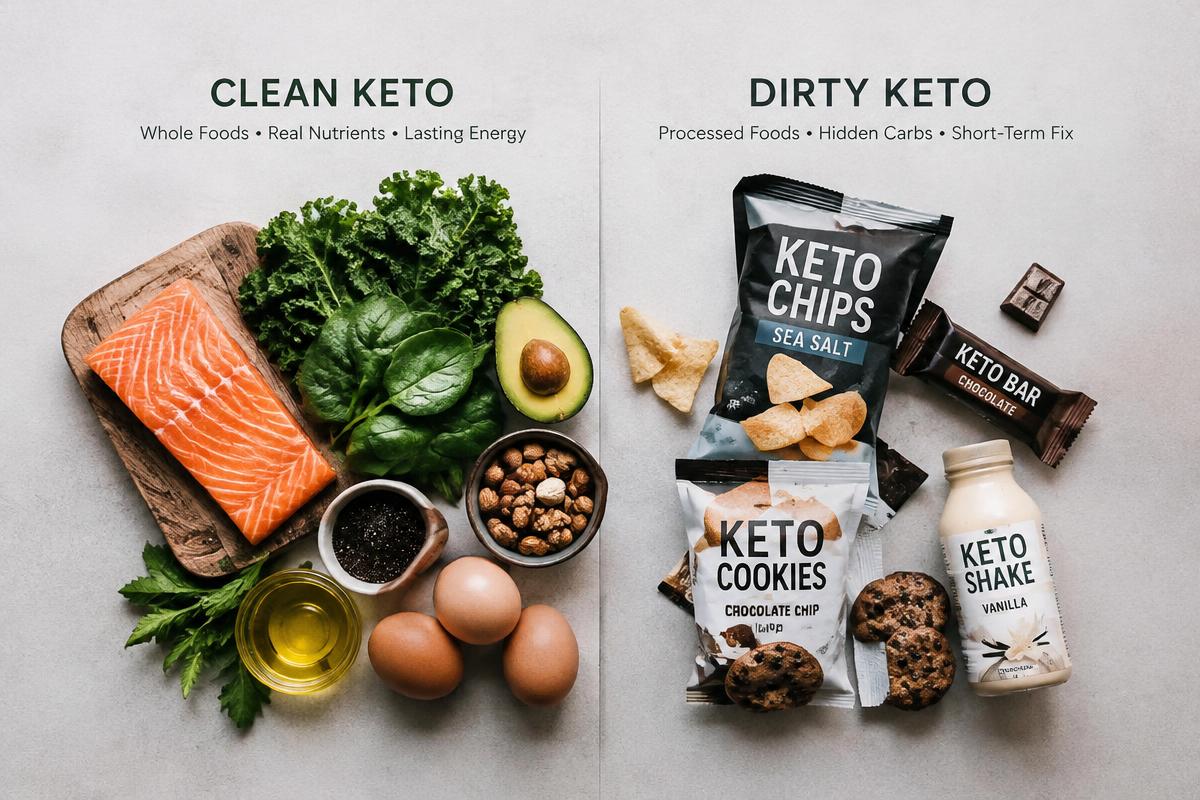
Clean keto is not an official medical term — it is a community label that generally refers to building your low-carb, high-fat diet primarily from whole, minimally processed foods. Think pasture-raised eggs, grass-fed beef, wild-caught fish, olive oil, avocado, leafy greens, cruciferous vegetables, nuts and seeds in moderation, and healthy fats like coconut oil or ghee. Clean keto eaters tend to avoid or minimize artificial sweeteners, processed meats loaded with nitrates, seed oils, packaged 'keto' snack foods, and diet sodas.
The philosophy behind clean keto borrows heavily from whole-foods nutrition science more broadly: the idea that food quality matters independently of macronutrient content. A person eating clean keto is trying to optimize not just for ketone production, but for micronutrient density, fiber intake (within the limits of a low-carb diet), reduced inflammatory load, and long-term metabolic health markers like triglycerides, HDL cholesterol, and blood pressure.
Typical Clean Keto Staples
- Pasture-raised or organic eggs cooked in butter or ghee
- Wild-caught salmon, sardines, and other fatty fish
- Grass-fed or pasture-raised meats without added sugars or fillers
- Non-starchy vegetables such as spinach, broccoli, zucchini, and cauliflower
- Avocados, olives, and cold-pressed olive or avocado oil
- Raw or lightly processed nuts and seeds in controlled portions
- Fermented foods like sauerkraut or plain full-fat yogurt for gut health
- Filtered water, herbal tea, and black coffee instead of diet soda
What 'Dirty Keto' Actually Means
Dirty keto flips the priority order: the only thing that matters is hitting your macro targets — high fat, moderate protein, very low carbohydrate — regardless of where those macros come from. A dirty keto day might include a fast-food double cheeseburger with the bun removed, pork rinds, string cheese, a diet cola, and a low-carb protein bar loaded with sugar alcohols. Every one of those foods can fit into a ketogenic macro split, and none of them will necessarily kick you out of ketosis.
Dirty keto became popular precisely because it lowers the barrier to entry. Cooking from scratch every day, sourcing grass-fed meat, and avoiding all processed food is expensive and time-consuming. Dirty keto lets people who travel frequently, eat out often, or simply do not enjoy cooking still participate in a ketogenic lifestyle using convenience foods, restaurant menus, and packaged keto-friendly products.
Typical Dirty Keto Staples
- Fast-food burgers or chicken ordered 'protein style' without the bun
- Processed deli meats, bacon, and pre-packaged cheese sticks
- Diet sodas and artificially sweetened drinks
- Low-carb protein bars and 'keto' packaged snacks with sugar alcohols
- Pork rinds and fried snack foods
- Heavy cream in coffee multiple times a day as a quick fat source
- Restaurant sauces and dressings without checking added sugar content
Do They Both Produce Ketosis?
Yes, in most cases, and this is the core truth that dirty keto advocates lean on. Ketosis is a metabolic state driven primarily by carbohydrate restriction, not by food quality. If you keep net carbs low enough — typically under 20 to 50 grams per day depending on individual tolerance — your liver will start converting fat into ketone bodies for fuel whether that fat came from a grass-fed ribeye or a fast-food bacon cheeseburger. If your only goal is to see a plus sign on a ketone test strip or a certain reading on a blood ketone meter, dirty keto will get you there just as reliably as clean keto.
But 'ketosis' is a narrow, single-variable outcome. It says nothing about your fiber intake, your sodium-to-potassium ratio, your intake of omega-6-heavy seed oils relative to omega-3s, your exposure to nitrates and nitrites, or how satiated you feel after a meal — all of which differ significantly between a plate of wild salmon and asparagus and a plate of gas-station pork rinds and diet soda.
Where the Two Approaches Diverge in Practice
Micronutrient Density
Whole foods carry a payload of vitamins, minerals, and phytonutrients that processed foods generally lack or have stripped out during manufacturing. Leafy greens provide magnesium and potassium — two electrolytes that are already at higher risk of depletion on a ketogenic diet due to increased water and sodium excretion. Grass-fed meats tend to carry a somewhat better omega-3 to omega-6 ratio than conventional, grain-finished meats. Clean keto eaters are simply more likely to hit their micronutrient targets without needing to rely heavily on supplements, though even clean keto often benefits from magnesium or electrolyte support, especially during the first few weeks of adaptation covered in our beginner keto guide.
Satiety and Appetite Control
One underrated advantage of whole-food keto is satiety. Fiber-containing vegetables, healthy fats, and unprocessed protein sources tend to be more filling per calorie than processed, hyper-palatable foods engineered to encourage overeating. Dirty keto foods — bacon, cheese, fried pork rinds, and processed snack items — are often designed with a flavor and texture profile that keeps you reaching for more, even after your caloric or macro needs have technically been met. This does not mean dirty keto foods cannot be eaten in a controlled way, but it does mean they require more conscious portion discipline to avoid passive overeating, which can stall weight loss even while you remain in ketosis.
Additives, Sweeteners, and Gut Health
Many packaged 'keto' snacks and dirty keto convenience foods rely on sugar alcohols such as maltitol, erythritol, or artificial sweeteners like sucralose to hit a low net-carb count while still tasting sweet. For some people these cause noticeable digestive distress — bloating, gas, or diarrhea — especially in the quantities found in multiple bars or drinks per day. There is also ongoing research interest in how certain artificial sweeteners may influence the gut microbiome and glucose response, though the evidence here is still developing and should not be treated as settled science. Clean keto, by relying on whole foods and naturally low-carb produce, sidesteps most of this category of concern entirely.
Cost and Convenience
This is dirty keto's clearest advantage. Grass-fed beef, wild-caught fish, and organic produce cost meaningfully more than their conventional counterparts, and sourcing them takes more planning, more cooking time, and often more than one grocery stop. Dirty keto lets someone on a tight budget or a demanding schedule stay in ketosis using regular supermarket staples, deli meat, and fast-food modifications. For many beginners, dirty keto is genuinely the only realistic on-ramp, and a strict clean keto standard from day one can create so much friction that people give up on the diet altogether.
Sodium and Cardiovascular Considerations
Processed meats, fast food, and packaged snacks tend to be extremely high in sodium, and while some added sodium is actually necessary on keto to offset increased fluid loss, the amounts found in a dirty keto day can regularly exceed recommended upper limits, especially for people managing blood pressure. Clean keto eaters who season food themselves have far more control over exactly how much sodium they are consuming and where it is coming from.
The Case Against Being a Purist
It is worth saying clearly: clean keto is not automatically 'better' in every dimension, and treating it as a moral high ground can backfire. Some people spend so much energy sourcing perfect ingredients that they burn out on the diet within a month. Others develop an unhealthy anxiety around any packaged or convenience food, which can spill into disordered eating patterns. A sustainable approach to keto has to account for real life: work travel, family meals, budget constraints, and the simple fact that cooking every single meal from scratch is not realistic for most people long term.
The middle ground that works for most successful long-term keto dieters looks less like a strict binary and more like a spectrum, where the goal is to make the whole-food choice the default whenever it is reasonably convenient, while allowing dirty keto shortcuts during travel, busy weeks, or social situations without guilt.
A Practical Framework: The 80/20 Hybrid Approach
Rather than picking a side, consider building roughly 80% of your intake from clean, whole-food sources and allowing 20% flexibility for convenience foods, restaurant meals, or packaged products when life gets busy. This mirrors the 80/20 principle used successfully in many other sustainable eating patterns and keeps you from either the expense and rigidity of full clean keto or the long-term nutrient and satiety downsides of full dirty keto.
- Build your weekday breakfasts and dinners around whole foods you cook at home using our 7-day keto meal plan as a starting template
- Allow one or two convenience meals per week — a modified fast-food order, a pre-made keto meal kit, or a restaurant dish — without guilt
- Choose whole-food electrolyte sources like leafy greens, avocado, and bone broth most days, and reserve electrolyte supplements for travel days or workouts
- Read labels on packaged 'keto' snacks even when they fit your macros, watching specifically for sugar alcohols, seed oils, and sodium load
- Batch-cook clean staples like roasted vegetables, grilled proteins, and homemade dressings on a weekend to make the convenient choice also the clean choice during the week
How to Decide Where You Fall on the Spectrum
If Your Priority Is Weight Loss Alone
If short-term weight loss is your only goal and you are disciplined about portion control, dirty keto can work, since ketosis and a calorie deficit are the primary drivers of fat loss. That said, the lower satiety and higher palatability of many dirty keto convenience foods make it easier to accidentally overeat, so if you notice your weight loss stalling even while staying under your carb limit, shifting toward more whole-food meals is often the fix — a pattern we cover in more depth in our article on common reasons a keto weight loss plateau happens.
If Your Priority Is Long-Term Metabolic Health
If you are using keto to manage blood sugar, improve cholesterol markers, or support long-term cardiovascular and metabolic health, leaning more heavily toward clean keto gives you better control over the quality of fats, sodium levels, and micronutrient intake that influence those outcomes over months and years, not just weeks.
If Your Priority Is Simply Staying Consistent
For many people, the diet that works is the diet they can actually sustain. If a rigid clean keto standard makes you quit after three weeks, a more flexible dirty-leaning approach that you can maintain for a year will produce better real-world results than a theoretically 'perfect' diet you abandon.
Common Pitfalls With Each Approach
- Dirty keto pitfall: relying on processed meats and cheese so heavily that fiber intake drops to near zero, causing constipation
- Dirty keto pitfall: underestimating hidden carbs in sauces, dressings, and 'keto' marketed products that are not as low-carb as advertised
- Clean keto pitfall: spending so much time and money sourcing ingredients that the diet becomes unsustainable within a few months
- Clean keto pitfall: under-eating due to high food prep effort, leading to unintended calorie deficits that trigger fatigue or hormonal issues
- Both approaches: neglecting electrolytes, which remains one of the most common causes of the 'keto flu' regardless of food quality
What the Research Actually Supports
Most clinical research on ketogenic diets — including studies on epilepsy management and metabolic syndrome — has been conducted using structured, whole-food meal plans rather than 'dirty keto' convenience eating, largely because researchers need to control variables tightly. This means the strongest evidence base for ketogenic diets producing measurable health benefits leans toward the clean keto style of eating, even though the term itself is informal. That does not mean dirty keto 'doesn't work' for ketosis or short-term weight loss, but it does mean that if you are hoping for the broader metabolic benefits often associated with keto in the literature, whole-food quality likely plays a meaningful role that a strict macro-only approach does not capture.
How Clean and Dirty Keto Play Out for Specific Groups
Athletes and Active People
People training hard on keto have higher electrolyte and micronutrient turnover than sedentary dieters, which tends to tip the scale toward clean keto in practice, even if not by ideology. Whole-food carbohydrate-adjacent options like berries, root vegetables in small amounts, and nutrient-dense fats support recovery and joint health in ways that processed dirty keto staples generally do not. That said, plenty of endurance and strength athletes rely on convenience foods like jerky, cheese, and electrolyte drinks around training sessions purely for practicality, which shows the hybrid approach applies just as much to athletes as to anyone else.
People Managing Type 2 Diabetes or Prediabetes
For people using keto specifically to manage blood sugar, the quality distinction matters more than usual. Highly processed dirty keto foods often carry high sodium loads and, in the case of many packaged snack items, carry maltitol or other sugar alcohols that can still raise blood glucose meaningfully in sensitive individuals, even though they are marketed as keto-friendly. Clean keto's reliance on whole, unprocessed fats and proteins generally produces steadier post-meal glucose responses, which is one reason clinicians overseeing therapeutic ketogenic diets for metabolic conditions tend to favor whole-food structured plans over a loose, convenience-driven approach.
Busy Parents and Shift Workers
For people juggling unpredictable schedules, a strict clean keto standard can become one more source of stress rather than a health tool. In these situations, leaning further toward the dirty end of the spectrum on the busiest days, while protecting one or two clean, home-cooked meals per week as an anchor, tends to be more sustainable than an all-or-nothing standard that gets abandoned the first time a schedule falls apart.
A Side-by-Side Sample Day
Seeing both approaches laid out for a single day makes the practical differences concrete rather than abstract. Neither day below is 'wrong' from a ketosis standpoint — both keep net carbs low enough to sustain ketone production — but they differ substantially in fiber, sodium, and micronutrient content.
A Clean Keto Day
- Breakfast: three pasture-raised eggs scrambled in butter with spinach and avocado
- Lunch: grilled wild salmon over mixed greens with olive oil and lemon dressing
- Snack: a small handful of walnuts and celery sticks
- Dinner: grass-fed steak with roasted broccoli and a side of sauerkraut
- Drink: water, black coffee, and unsweetened herbal tea throughout the day
A Dirty Keto Day
- Breakfast: a fast-food sausage-and-egg patty with cheese, no bun, and a diet soda
- Lunch: a double cheeseburger ordered 'protein style' with extra mayo
- Snack: a packaged low-carb protein bar and a string cheese
- Dinner: pepperoni and cheese with pork rinds instead of crackers
- Drink: diet soda and heavy cream stirred into coffee twice during the day
Both days likely land in a similar macro range, but the clean keto day delivers meaningfully more fiber, potassium, magnesium, and omega-3 fats, while the dirty keto day delivers more sodium, more sugar alcohols, and less overall satiety per calorie. Comparing your own typical day against these two examples is a quick way to see where you currently sit on the spectrum without needing to track anything formally.
Social and Psychological Considerations
Diet quality debates can easily become a source of guilt, and it is worth naming that directly. People who eat more dirty keto than they would like sometimes internalize a sense of failure, even while successfully staying in ketosis and losing weight. On the other side, some clean keto eaters develop rigid, all-or-nothing thinking around food quality that makes normal social situations, like a birthday dinner or a work trip, feel like moral tests rather than simply part of life. Recognizing that both extremes can create unnecessary psychological strain is part of building a version of keto you can actually live with for years, not just weeks.
- Notice if you feel shame after eating a convenience-based meal even though it kept you in ketosis — that reaction is a signal to loosen your standards, not tighten them
- Notice if you feel anxious about eating anywhere other than your own kitchen — that reaction is a signal to build more flexibility into your plan
- Judge your diet by trends over weeks and months, not by any single meal or day
Bringing It Together
Clean keto and dirty keto are best understood not as opposing philosophies but as two ends of a spectrum, each with legitimate strengths. Dirty keto lowers the barrier to entry and works well for people who need convenience, travel frequently, or are on a tight budget, provided they stay mindful of sodium, sugar alcohols, and portion sizes. Clean keto offers better micronutrient density, satiety, and alignment with the research base behind keto's broader health claims, but demands more time, money, and planning. For most people, the realistic and sustainable answer is a hybrid: build the majority of your meals from whole foods, and allow convenience foods to fill the gaps life inevitably creates, using tools like our keto grocery list to keep your default choices clean without turning every meal into a project.
Frequently asked questions
Can you lose weight on dirty keto?
Yes. Weight loss on keto is driven primarily by staying in a calorie deficit while keeping carbohydrates low enough to sustain ketosis, and dirty keto foods can fit those parameters. However, many dirty keto foods are less filling per calorie, which can make portion control harder and lead to plateaus over time.
Is dirty keto bad for your health?
Dirty keto is not inherently dangerous for most healthy adults in moderation, but relying on it constantly can mean higher sodium intake, lower fiber and micronutrient intake, and more exposure to processed ingredients, which may affect long-term cardiovascular and digestive health.
Do I have to choose one approach permanently?
No. Most sustainable keto diets exist on a spectrum. Many people default to clean keto at home and allow dirty keto flexibility while traveling, at work events, or during busy weeks.
Does clean keto put you into ketosis faster than dirty keto?
Not necessarily. Ketosis depends primarily on total carbohydrate intake, not food quality. Both approaches can produce ketosis at similar speeds if carb intake is controlled equally.
Is dirty keto a good starting point for beginners?
It can be. Many beginners find dirty keto easier to start because it uses familiar convenience foods and restaurant modifications, lowering the initial barrier to entry. Shifting gradually toward more whole-food meals over the following weeks often improves satiety and micronutrient intake without requiring a difficult all-or-nothing switch on day one.
How can I tell if I lean too far toward dirty keto?
Common signs include frequent constipation from low fiber intake, regular headaches or bloating linked to high sodium and sugar alcohol intake, and feeling hungry again shortly after meals despite hitting your fat and calorie targets. If several of these apply, shifting a few meals per week toward whole-food options is a reasonable first adjustment.
References
Elena Marsh
Founding Editor · Certified Nutrition Coach (NASM-CNC)
Elena has spent a decade developing low-carb recipes and translating peer-reviewed nutrition research into plain-English guides for home cooks.
More from Elena →