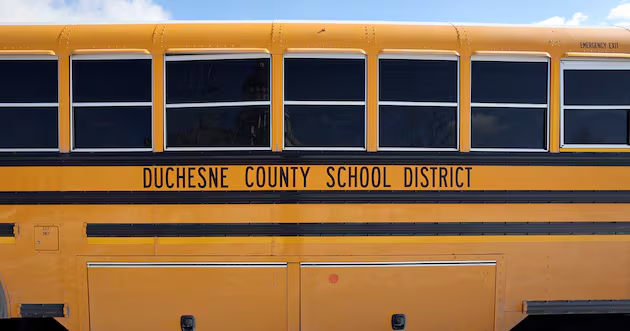
- Utah Gov. Spencer Cox on Thursday vetoed a bill that would have helped equip rural school buses with internet service.
- The governor vetoed only two bills from the 2026 legislative session.
- Fewer bills have landed on Cox’s desk this year — “and that’s a good thing.”
It’s no secret that Gov. Spencer Cox is wary of technology entering Utah’s K-12 schools.
Even before the 2026 Utah Legislature began its session, the governor held a press conference at the Capitol advocating for a bill banning the use of cell phones in schools that was eventually approved.
And during the Show Up for Teachers conference last year, Cox warned of the dangers of AI becoming more widely used in the lives and classrooms of Utah students.
“Artificial intelligence,” he said at the conference, “is more stupid than it will be right now — and it’s smarter than most of us are right now.”
So it’s perhaps no surprise that Cox on Thursday vetoed a bill that would have expanded internet access for rural Utah students.
It marked the last day the governor could sign or veto bills from the 2026 session.
Sponsored by Rep. Tiara Auxier, R-Morgan, House Bill 462 proposed that state grants be made available to rural school districts to provide internet connectivity on school buses.
Children in rural Utah schools, Auxier said in a bill presentation to lawmakers, often participate in many extracurricular activities. Their bus ride to and from school often takes several hours, and students return home long after dark.
Missed homework and sleepless kids are often the result of long school bus rides.
“When I played sports, I could do my homework on the bus and do it with pencil and paper,” Auxier said. “Now our kids don’t have that luxury because everything is online and delivered on Chromebooks.”
Auxier also said the school bus internet connection will help Utah students who live in rural areas who often have long commutes to school each day.
Had HB462 passed Cox’s desk, each participating high school would have received the initial funding needed to equip a limited number of school buses used on long-distance trips with internet connectivity.
Cox: ‘Our kids need less screen time’
In a letter Thursday explaining his veto of HB462, Cox wrote that he respects Auxier’s goal of helping students complete their schoolwork while participating in extracurricular activities.
“And, as a student who grew up in a rural district, I recognize the added challenge of long bus rides for rural students,” he added.
“But I am very concerned about letting our students know that we are spending more time on devices than spending more time talking face-to-face. Our kids just need less time to watch and interact with people.”
Cox acknowledged the “practical reality” that today’s kids are being pushed to the devices to do their homework — “but it doesn’t have to stay that way.”
The governor praised the 2026 Legislature’s “smart effort” to divest itself of school equipment and the “good balance” of student technology use.
If this bill required schools to hand out paper assignments to students in extracurricular activities to help them complete their work, I would have supported it.
Health care loan denial
In Thursday’s letter, Cox explained that he was vetoing House Bill 164 “for some technical reasons.”
The patient care/health fund, according to the governor, was designed to better protect patients and their ability to bring complaints to the Division of Professional Licensing.
First, it would require health care providers and their staff to tell the patient how to file a complaint with the licensing department if the patient raises concerns about the provider’s conduct.
Second, noted Cox, the bill requires patient disclosure before a physician can enter into a settlement agreement that prevents the patient from filing a complaint with the DOPL.
A similar bill, Senate Bill 117, made it unconstitutional for a provider to do anything that would prevent a patient from filing a complaint with the licensing department, including a settlement agreement that prevented the patient from filing a complaint.
The provisions of the two bills, Cox wrote, were contradictory.
“To resolve these conflicts, and because I think that the policy of SB117 fulfills the stated purpose, I reject HB164.”
There is no signature for the precious coin
Meanwhile, Cox is allowing House Bill 195 to go into law without his signature.
The governor wrote that he vetoed a “similar bill” last year. This year’s measure “requires the state to ‘establish and operate a metal-backed electronic payment system for the benefit of the nation.'”
Cox said he received messages of both support and opposition to the bill.
“Although I expressed my concerns about this bill last year, the Legislature seems determined to pass the bill. …
Less debt by 2026 ‘a good thing’
In Thursday’s veto letter addressed to lawmakers and legislative leaders, Cox expressed gratitude for their collective efforts during the 2026 general session.
“This was a productive meeting, and Utahns are better off because of your work,” he wrote.
“I’ve said publicly that this was my favorite conference in the 14 years I’ve been involved in law enforcement.”
The governor noted that fewer bills have reached his desk this year – “and that’s a good thing.”
“More laws do not always mean better governance. As someone who believes in less government, I am encouraged every time our operations reflect ethics and morality.”
#Governor #Spencer #Cox #internet #service #rural #Utah #school #buses