On Thursday evening, the capital of Iran, Tehran, was attacked by heavy attacks. Residents reported fighter jets flying low over the city and loud explosions. In the early hours of Friday morning, the Israeli army said that it had carried out a large-scale attack on the “heart of Tehran” and had targeted “Iranian government equipment”.
Earlier, the US President, Donald Trump, had also postponed his threats to attack Iran’s energy facilities if Tehran refused to lift its blockade of the Strait of Hormuz. The US has sent thousands of troops to the Middle East. An Iranian ground attack has not been ruled out.
Iranians have no faith in the state media
On Thursday, Iran had said it launched missile and drone attacks on Israeli targets as well as American bases in several Gulf regions. Iran’s state television reports that the country is on the verge of defeating its enemies and ending the war.
A resident of Tehran wrote in a group discussion: “We don’t watch state television anymore, and nobody watches it anymore. Another wrote: “They only prove themselves and their supporters.
Iran’s national broadcaster, the Islamic Republic of Iran Broadcasting (IRIB), has long lost its influence on public opinion in the country. According to a survey conducted by the Iranian Student Election Center in Tehran, even before the Twelve-Day War between Iran and Israel in June 2025, only 12.5% of people relied on IRIB for their news, compared to 51% in 2017.
Despite a budget increase of about 50% by March 2025, the public broadcaster has not been able to regain the trust it has lost.
Internet is blocked, Starlink is blocked
Most Iranians get their news from Persian-language media abroad, from other state broadcasters like DW, or through social media, especially Instagram, which has 24 million users in Iran. Although such platforms are banned by law, many people use VPN services to access them. A VPN creates an encrypted data tunnel between a device and a remote server, through which users can connect to the Internet.
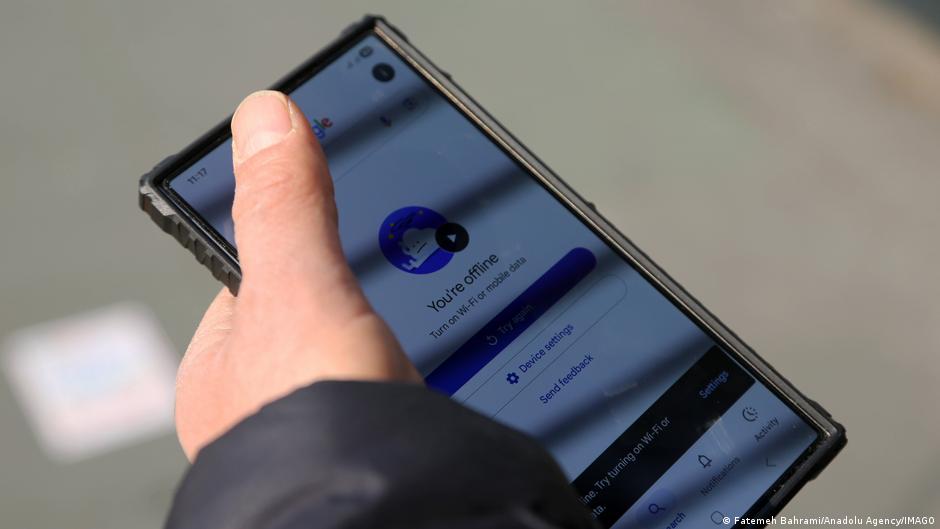
Since the US-Israel war with Iran began on March 28, Iranian authorities have also shut down the internet. Even VPN connections can only work with the help of satellite internet providers like Starlink, which is also banned in Iran. In addition, they are often very expensive to use and can cost up to 10 times the normal price. According to Iran’s Ministry of Intelligence, hundreds of Starlink systems have been tracked and confiscated across the country.
Internet expert Keyvan Samadi told DW how the security authorities were able to track the systems. He said that Starlink equipment transmits signals to connect to satellites. Special equipment could detect the signals and the radio could be used to locate them approximately. According to media reports, hundreds of people have been arrested that way since the beginning of the US-Israel war with Iran.
It is difficult to say how many banned systems are still being used in Iran. People still in the country told DW that VPN services are still available but at a very high price. Although many people faced financial difficulties due to the ongoing war and closed businesses, many were willing to spend a lot of money to get information.
Many said that on top of the drone and missile attacks, the internet blackout was an additional source of stress because people had lost contact with their relatives. They said that the uncertainty of what is happening is almost unbearable.
This article, to which Danyal Babayani contributed, has been translated from German.
#Shutting #internet #Iran #causing #fear #isolation